Amazon does not sponsor or endorse this site, and every recommendation here is my own. Product links on this page go to Amazon.com and are not affiliate links right now.
If you've ever cut into a chicken breast to check it, you already know why a meat thermometer earns its drawer space. Cutting lets juice escape, and color is a poor guide: meat can look done before it's safe, or stay pink when it's perfectly fine. A thermometer replaces the guessing with a number. A good basic one costs less than a pack of steaks and takes about two seconds to use.
This guide covers the two main types, what's worth paying for, and how to take a reading you can trust. It closes with the thermometer I'd suggest for most home cooks, plus two alternatives.
Instant-read vs. leave-in: which do you need?
| Instant-read | Leave-in (probe and alarm) | |
|---|---|---|
| How it works | You check by hand when you think food is close | A probe stays in the food on a heat-safe cable while it cooks |
| Best for | Steaks, chops, chicken pieces, burgers, fish, bread, reheated leftovers | Roasts, whole turkeys, smoked brisket, anything that cooks for an hour or more |
| Goes in the oven? | No, the body stays outside | The probe and cable do; the display sits outside |
| Main upside | Fast, cheap, checks several spots | Alarm at your target, so you don't open the oven |
For most kitchens, an instant-read thermometer is the one to buy first. It covers almost everything you cook on a weeknight. If you roast or smoke big cuts often, add a leave-in model later. Many people end up with both: the probe tracks the roast, and the instant-read double-checks a second spot before serving.
A thermometer replaces the guessing with a number.
What matters when you shop
- Speed. A thermometer that settles in a few seconds means less time with your hand over a hot grill and less heat lost from an open oven. Faster models cost more.
- Accuracy you can check. Look for a stated accuracy and a way to recalibrate. Either way, you can test it in ice water (steps below).
- A thin probe tip. A thin tip leaves a smaller hole and reads better in thin cuts like chicken cutlets or fish fillets.
- Probe length. About 4 inches reaches the center of a thick roast or a turkey breast.
- A readable display. A backlight helps at dusk on the grill. A display that rotates is nice, not essential.
- Temperature range. Meat only needs up to about 200°F, but candy and deep-frying run much hotter. Check the top of the range if you want one tool for all three.
- Water resistance. A rating like IP67 means you can rinse it under the tap. It still isn't a dishwasher item.
How to take a reliable reading
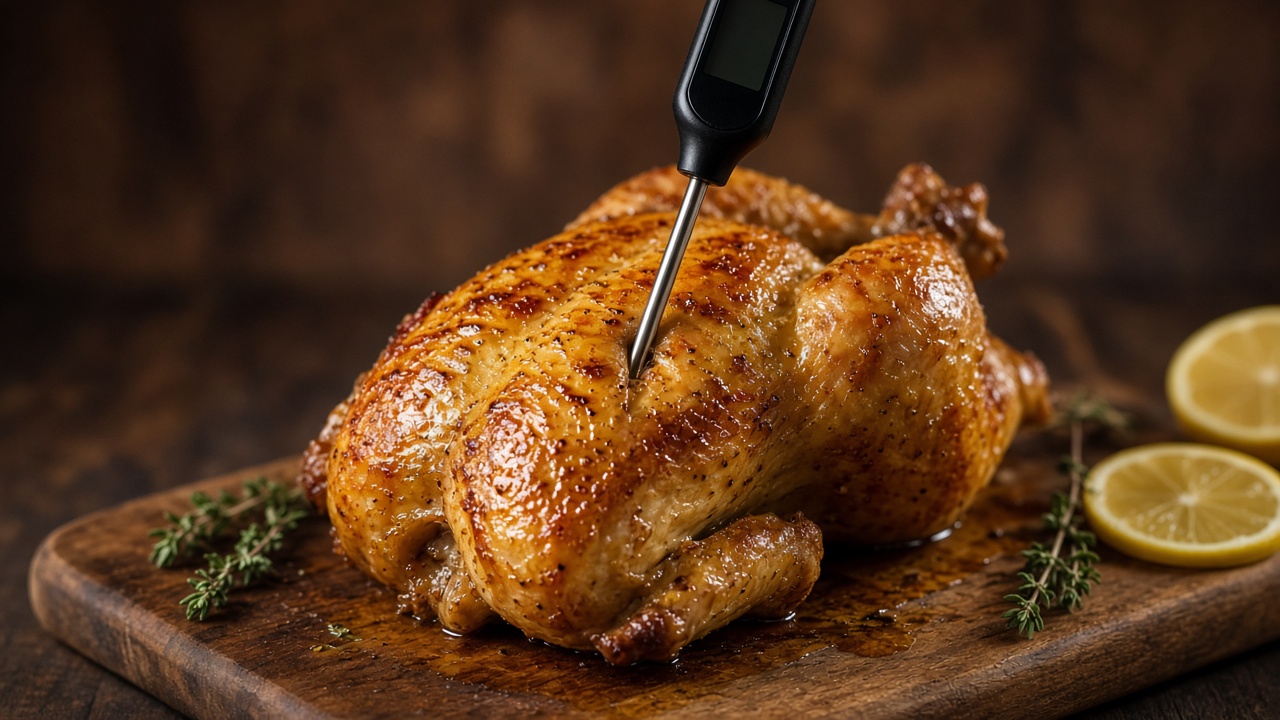
- Find the thickest partThat's where food cooks last. On a whole chicken or turkey, check the thickest part of the breast and the inner thigh.
- Avoid bone, fat and gristleBone conducts heat and reads high; fat and gristle read off too. Aim for solid meat.
- Go in from the side on thin cutsFor burgers, chops and chicken breasts, slide the probe in sideways so the tip sits in the middle rather than poking out the bottom.
- Let the number settleWait until the reading stops climbing, then move the tip slightly deeper and shallower. The lowest number you see is the one that counts.
- Check more than one spot on big cutsRoasts and birds cook unevenly. If two spots disagree, go by the lower one.
- Clean between raw and cookedIf you probed raw or undercooked meat, wash the probe in hot soapy water before checking food that's ready to eat.
Safe minimum internal temperatures
From FoodSafety.gov, last reviewed Nov 21, 2024.
| Food | Safe minimum |
|---|---|
| Beef, pork, lamb, veal steaks, roasts and chops | 145°F (63°C), then rest 3 minutes |
| Ground beef, pork, lamb and sausage | 160°F (71°C) |
| All poultry, whole or in pieces, including ground | 165°F (74°C) |
| Fish | 145°F (63°C), or until flesh is opaque and flakes easily |
| Egg dishes such as quiche and frittata | 160°F (71°C) |
| Leftovers and casseroles | 165°F (74°C) |
These are safety minimums, not always the doneness you want. Many cooks like steak above 145°F, and chicken thighs are often more tender cooked past 165°F. If you're cooking a steak or roast to a higher doneness, pull it a few degrees early: the temperature keeps rising a little while it rests. When you're cooking to a safety minimum, especially poultry and ground meat, make sure the reading actually reaches it.
Check it in ice water
- Pack a glass with iceFill it to the top with ice, then add cold water. Stir and wait a couple of minutes.
- Insert the probe in the middlePut the tip about 2 inches deep, not touching the glass or the bottom.
- Look for 32°F (0°C)If it's off by more than a degree or two, use the recalibration steps in the manual, or remember the difference.
Common mistakes
- Checking too early, and too often, with a leave-in roast. Open the oven only when the alarm or the time says you're close.
- Probing near the surface. Food is hottest outside and coolest in the center.
- Trusting the pop-up timer in a turkey. Check the breast and thigh yourself.
- Leaving an instant-read thermometer in the oven or on a closed grill. The body isn't made for that heat.
- Ignoring a weak battery. A dim display or slow reading often means it's time for a new one.
 My pick
 for most home cooks: Alpha Grillers Meat Thermometer Digital
The Alpha Grillers is a simple, well-established instant-read thermometer that does the core job without fuss. Its probe folds out from the body. The maker says it reads in 1 to 2 seconds and arrives pre-calibrated, with a recalibration option if it drifts. The display is backlit. It's rated IP67, so you can rinse it under running water, though the listing still says hand wash only. It runs on one CR2032 coin battery, and you can buy it with or without a spare.
Alpha Grillers Meat Thermometer Digital
Check the current price on AmazonTwo alternatives worth knowing
- If you want the fastest and most accurate: ThermoWorks Thermapen ONE. ThermoWorks lists 1-second readings, ±0.5°F accuracy from -4 to 248°F, a calibration certificate and a 5-year warranty. It costs several times more than a basic model, and ThermoWorks says it's being retired, so check what's replacing it before you buy.
- If you roast or smoke big cuts: ThermoWorks DOT. It's a simple leave-in alarm thermometer. You set a target, a probe on a 47-inch heat-safe cable stays in the meat, and it beeps when you get there.
The bottom line
Buy an instant-read thermometer first, learn to find the thickest part, and check it in ice water now and then. That one habit will improve your cooking more than almost any other gadget. Add a leave-in model when you start doing long roasts or smokes.